
The Race Across Benelux 2027 routes are being revealed!
From the 200 km to the 1,000 km challenge, discover in detail the routes designed for this new edition, featuring legendary cycling routes, diverse landscapes, cultural heritage, the Flemish hills, the Ardennes, and the Belgian coast. Four distances, four unique experiences: we’ll take you on a journey to discover what awaits participants in 2027.
1,000 km: The Great Benelux Crossings
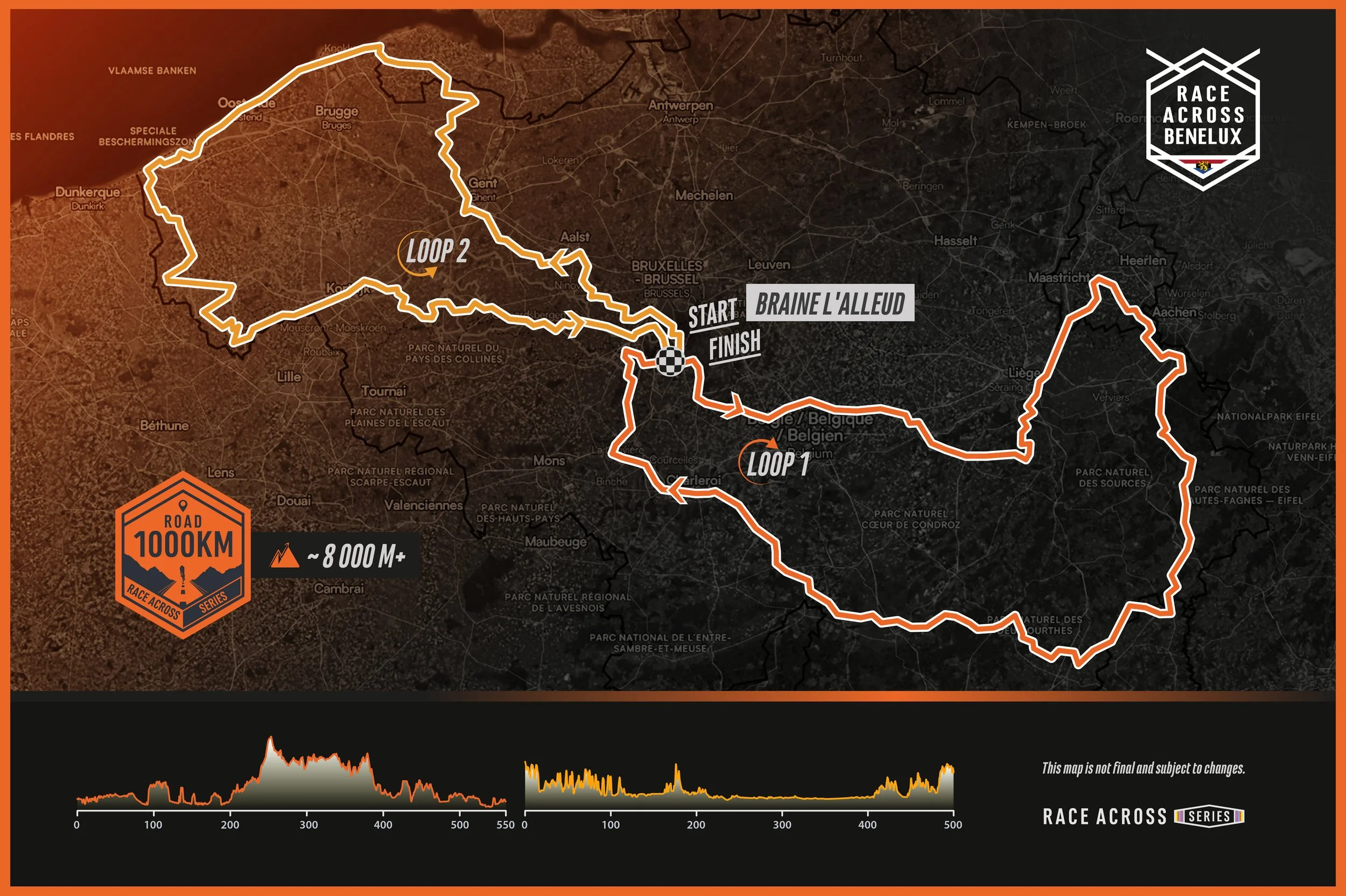
Illustrations of the Race Across Benelux routes. ⚠️ All our routes are still subject to change pending prefectural approvals and route inspections conducted up to a few weeks before the race. Please note that these routes may still change—the GPX files will be sent 30 days before the event.
First 500-km loop: the classics, the Hautes Fagnes, and the Ardennes
This first loop is the most mountainous of the 1,000 km route. It combines major cycling climbs, unspoiled landscapes, the Hautes Fagnes, the German-speaking region of Belgium, Luxembourg, and the Ardennes.
After starting out together on the 200-km route near Villers-la-Ville and Gembloux, participants will pass through the Éghezée region and the Burdinale-Mehaigne Nature Park.
Next comes one of the race’s highlights: the Mur de Huy, the famous climb of the Flèche Wallonne. The route continues through the Ourthe Valley before reaching La Roche-aux-Faucons, another iconic climb of Liège-Bastogne-Liège.
Three iconic cycling landmarks will be featured on this loop: the Mur de Huy, the Roche-aux-Faucons, and, a little later, the Cauberg in the Netherlands—the famous climb from the Amstel Gold Race.
After these classic routes, participants will head toward the Hautes Fagnes and the Signal de Botrange, Belgium’s highest point at 694 meters. This will be an opportunity to symbolically approach the 700-meter mark.
The route will then pass through the German-speaking region, including Raeren, Eupen, and Saint-Vith, before entering the Grand Duchy of Luxembourg from the north, near Drinklange and Troisvierges.
The route then returns to the Belgian Ardennes, north of Bastogne, through vast forested areas. The route will take participants back toward the Dinant region, the Meuse Valley, Mettet, Charleroi, La Louvière, and the canals, before reaching Braine-l'Alleud.
A particularly challenging loop, with 5,710 meters of elevation gain, that combines major climbs, mountainous landscapes, forests, borders, and regions with diverse identities.
Second 500-km loop: the Flemish hills, the North Sea, and the plain
The second loop offers a completely different experience. It is organized around three main regions: the Flemish hills, the Belgian coast, and the vast plains of Flanders.
The start will mark a return to the legendary routes of the Flemish classics. The Mur de Grammont, the Taaienberg, the Koppenberg, the Waaierberg, the Paterberg, and many other climbs will set the pace for this first part of the course.
After Kortrijk, the route will continue toward the French border, passing through the Kemmelberg and several iconic cobbled sections of Flemish races, before heading back up toward Ypres and the North Sea.
Next, the Belgian coast will take center stage. Participants will head to La Panne, cross the Westhoek Nature Reserve, and follow nearly 70 kilometers of coastline, passing through Ostend, among other places.
Further east, Knokke-Heist and the Zwin Nature Reserve offer a different view of the coastline, before a brief detour into the southern Netherlands, through the polders.
It will then be time to leave the coast behind and head toward Ghent, crossing the vast Flemish plains. A long, relatively flat stretch lies ahead, before the first challenges arise as we approach Aalst.
The final stretch of the route will present a few challenges, including the climbs at Liedekerke and Rhode-Saint-Genèse, before reaching Cardinal Mercier High School.
A loop trail full of contrasts, with a total elevation gain of 2,710 meters and a wide variety of landscapes.
500 km: Two Faces, Two Atmospheres of Belgium
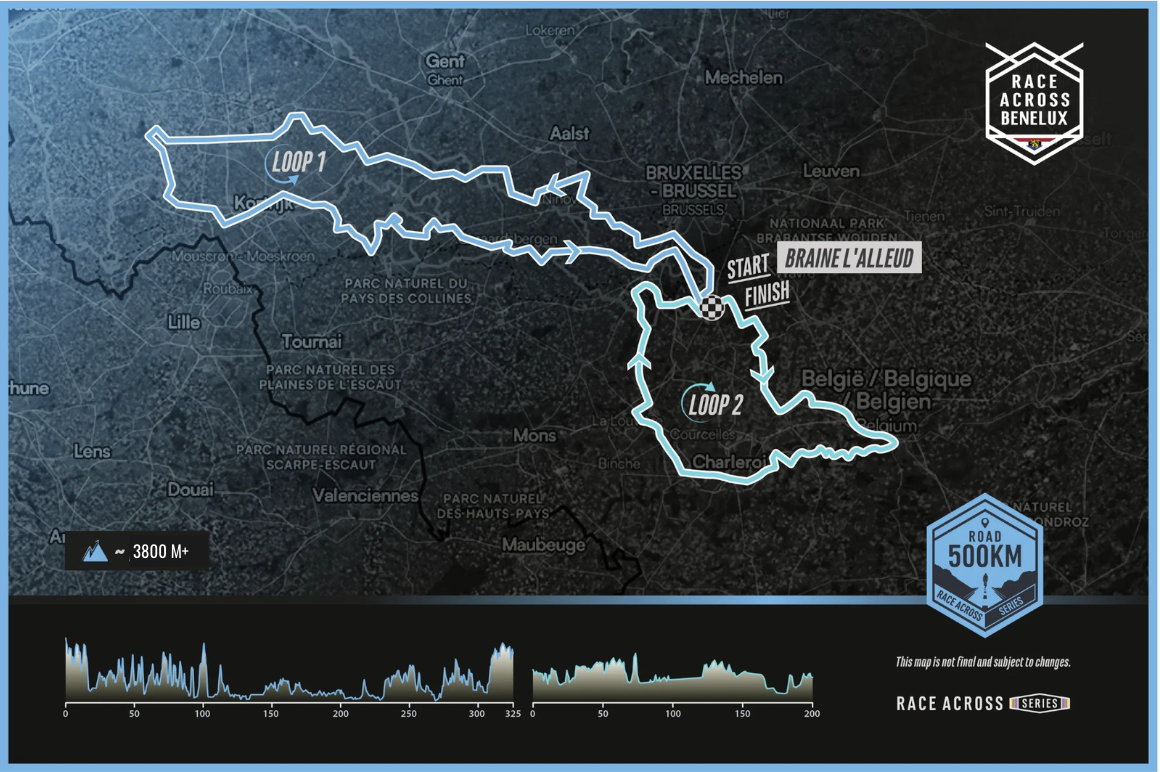
Illustrations of the Race Across Benelux routes. ⚠️ All our routes are still subject to change pending prefectural approvals and route inspections conducted up to a few weeks before the race. Please note that these routes may still change—the GPX files will be sent 30 days before the event.
The 500-km route follows the exact same paths as the 300-km and 200-km routes. The idea is simple: to offer a complete experience by bringing together two worlds, each of which showcases a different facet of Belgium.
Part 1: 300 km—In the Footsteps of the Flemish Classics
Starting from Waterloo, participants will head west toward the famous Wall of Geraardsbergen, before tackling several iconic climbs in Flemish cycling: Oudeberg, Foreest, Taaienberg, Koppenberg, Waaierberg, Paterberg, and Zwegberg.
A true return to the roots of cycling, on roads steeped in history and memories of past races. The small climbs come one after another, there are numerous accelerations, and opportunities to recover are sometimes scarce. With 2,410 meters of elevation gain, this first section already promises to be a demanding and grueling course, especially in the final kilometers.
The return trip will follow a loop further north, before encountering new challenges near Liedekerke and Rhode-Saint-Genèse.
Part Two: 200 km—Wallonia's Many Faces
After the Flemish hills, it’s time for a completely different setting in the second leg, which follows the route of the 200 km By Night race.
Participants will set out to explore Walloon Brabant and its rolling countryside before heading to Villers-la-Ville and its impressive abbey ruins. They will then continue on to Namur and its Citadel, an iconic stop on the Grand Prix de Wallonie route.
The route will continue along the Sambre Valley toward Charleroi and its industrial heritage. Near La Louvière, towpaths, boat lifts, and large engineering structures will dot the route.
Ronquières, with its boat ramp, the Samme Valley and its locks, and then Braine-le-Château with its medieval charm, will accompany participants all the way to Braine-l'Alleud and the Cardinal Mercier Middle School.
With a relatively moderate elevation gain of 1,420 meters, this route highlights the diversity of the landscapes, historic sites, and discoveries along the way.
300 km: Back to Basics, Following in the Footsteps of the Flemish Classics
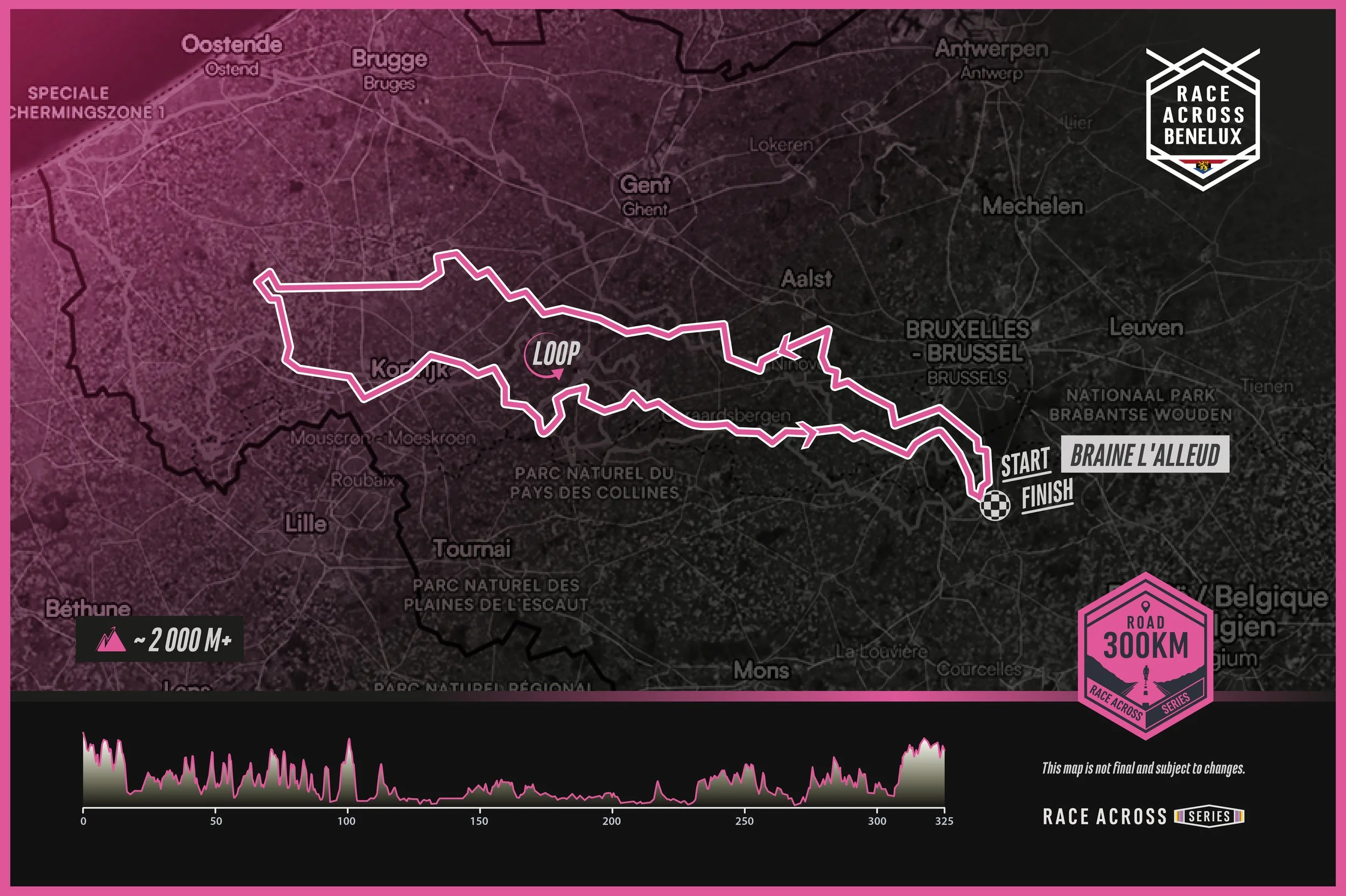
Illustrations of the Race Across Benelux routes. ⚠️ All our routes are still subject to change pending prefectural approvals and route inspections conducted up to a few weeks before the race. Please note that these routes may still change—the GPX files will be sent 30 days before the event.
With the 300 km race, the atmosphere changes. Here, the focus shifts to the roads that have shaped the history of Belgian cycling and the Flemish hills that have made the major classics famous.
Starting from Waterloo, participants will head west toward the famous Wall of Geraardsbergen. They will then tackle a series of legendary climbs: Oudeberg, Foreest, Taaienberg, Koppenberg, Waaierberg, Paterberg, and Zwegberg.
A true return to the roots of cycling, on roads steeped in history and memories of races.
The route will then head back via a loop further north, before facing new challenges near Liedekerke. Rhode-Saint-Genèse will be one of the last major climbs before the finish at Collège Cardinal Mercier.
With 2,410 meters of elevation gain, this 300-kilometer route might surprise those who imagine Belgium as a mostly flat country. The small climbs come one after another, there are numerous accelerations, and opportunities to recover are sometimes scarce.
A demanding, grueling course that could prove particularly difficult in its final kilometers.
200 km By Night Go’Lum Experience: Wallonia’s Many Faces
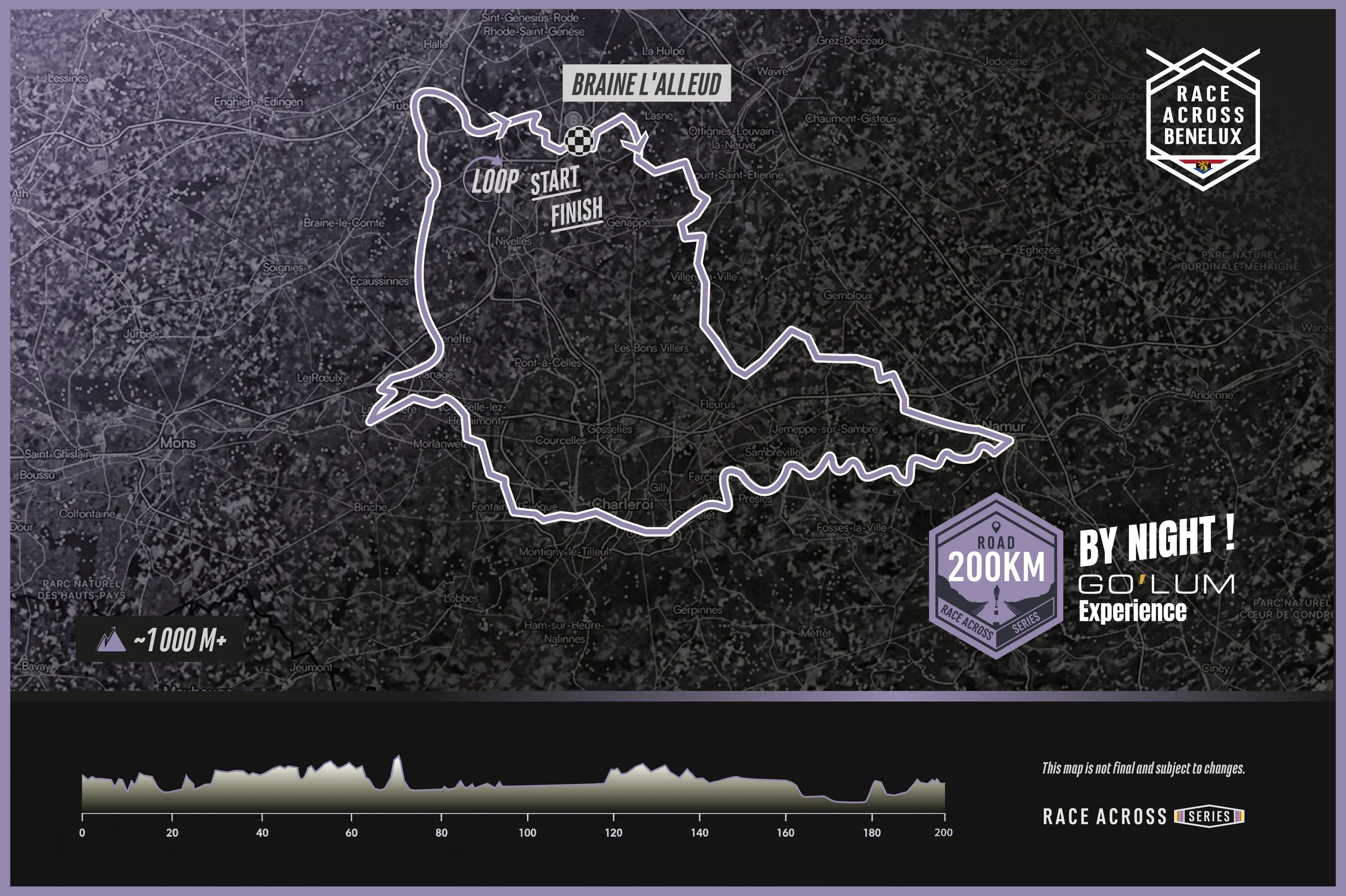
Illustrations of the Race Across Benelux routes. ⚠️ All our routes are still subject to change pending prefectural approvals and route inspections conducted up to a few weeks before the race. Please note that these routes may still change—the GPX files will be sent 30 days before the event.
The 200 km By Night is an invitation to discover Wallonia in a different way. With a relatively moderate elevation gain of 1,420 meters— —this route highlights the diversity of the landscapes, historic sites, and discoveries along the way.
After leaving Waterloo, participants will travel through the rolling countryside of Walloon Brabant before reaching Villers-la-Ville and its impressive abbey ruins. They will then head to Namur, where the Citadel offers an iconic stretch of road, best known for the Grand Prix de Wallonie.
The route will continue along the Sambre Valley toward Charleroi and its industrial heritage. The scenery will change once again near La Louvière, with its towpaths, boat lifts, and large engineering structures.
Ronquières, its boat ramp, the Samme Valley, and its locks will round out this journey. Participants will also pass through Braine-le-Château, a town with a medieval atmosphere, before reaching Braine-l'Alleud and the Cardinal Mercier Middle School.
The 200 km route is, above all, a journey of discovery: a rich, diverse, and surprising Wallonia, where nature, cultural heritage, history, and industrial heritage come together.
