
RACE ACROSS BENELUX 2026 - Ultra Cycling: DETAILED ROUTES
Race Across Benelux 1000 km – Between plains, plateaus, steep-sided valleys, and beer culture: the Benelux like you've never seen it before. Ultra cycling in the north.
Route designed by Race Across - mapped out and surveyed by Ben Georges and his team.
All our routes are still subject to modification following prefectoral authorizations and reconnaissance carried out up to a few weeks before the race. Please note that these routes are still subject to change - GPX files will be sent 30 days before the event.
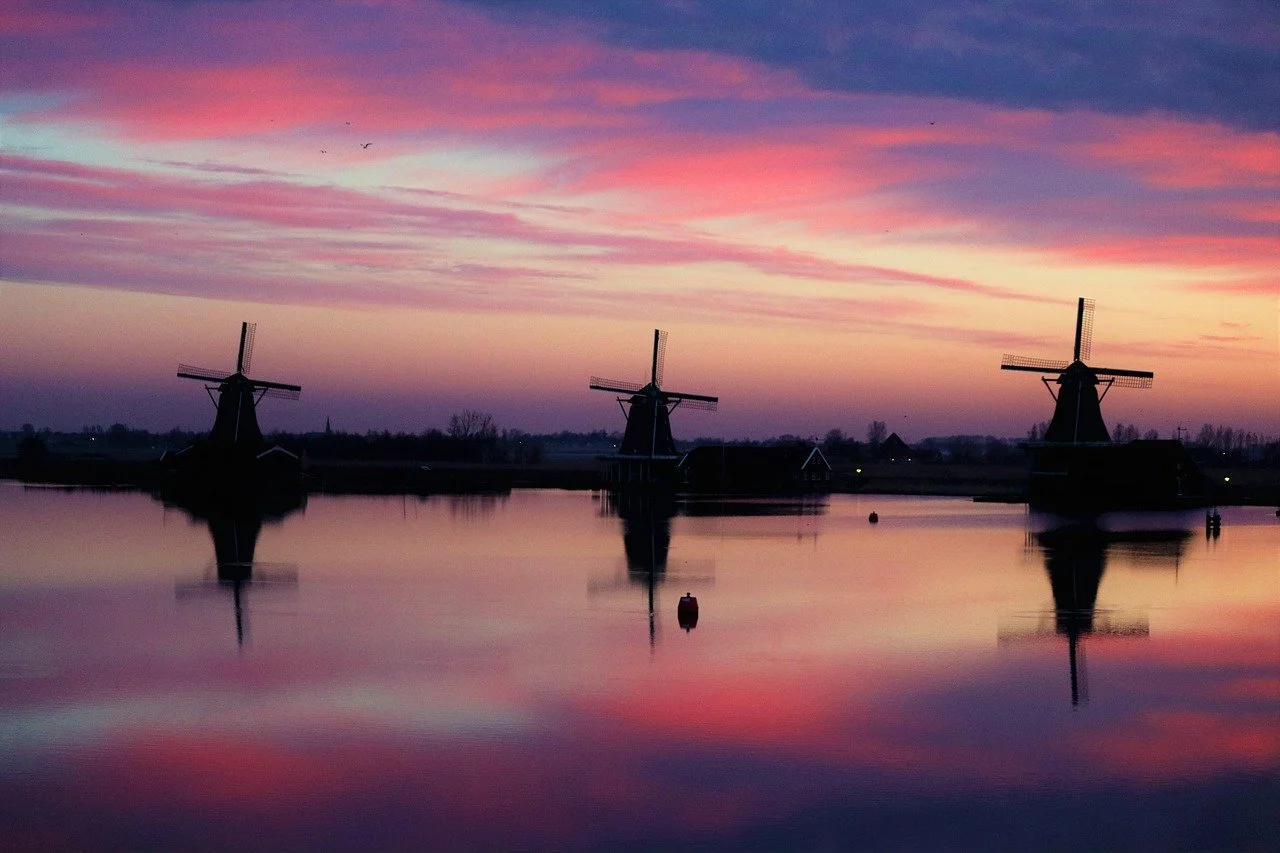
Royalty-free photo, landscapes of the race across Benelux
The Benelux is not just a mosaic of countries. It is a triple identity. A territory where you can glide from the flat horizons of Amsterdam to the valleys of the Ardennes, where borders fade away, where cultures mix, where beer tells the story. In 2026, the Race Across Benelux 1000 km offers you a unique adventure in two acts: a crossing from Amsterdam to Arlon, followed by a loop from Arlon to Arlon that is wilder, steeper, and more inland.
Two very different paths. One promise: a dense, intense, cultural, and unexpected challenge at the heart of three countries with strong identities.
IDENTITY CARD — RACE ACROSS BENELUX 1000 KM
🏁 Format: Cross-country + loop (Amsterdam → Arlon → Arlon)
📍 Start: Amsterdam
Date: race bib collection race bib start May 27, 2026
🎯 Finish: Arlon (Belgium)
🌍 Countries crossed: Netherlands → Belgium → Luxembourg
📏 Total distance: 1048 km
⛰ Total elevation gain: ≈ 11,900 m
🔁 Structure:
Part 1: Amsterdam → Arlon (533.5 km – ~4,700 m elevation gain)
Part 2: Arlon loop → Arlon (515.3 km – 7,165 m elevation gain)
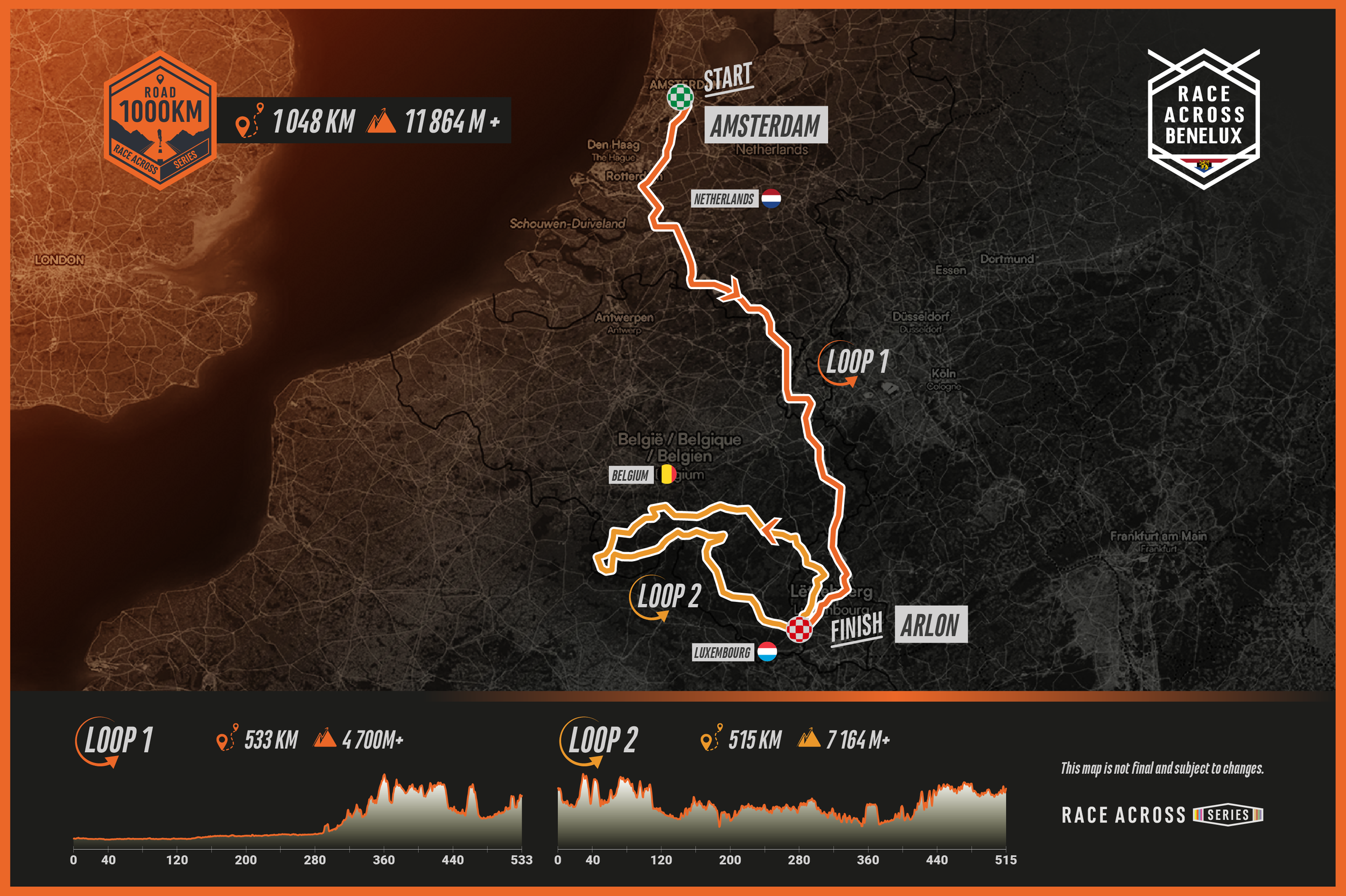
Illustration: Race Across Benelux 1000km - Edouard Hanotte
Iconic areas:
Amsterdam, Rotterdam, Gouda, enclaves of Baarle-Hertog/Nassau, Limburg, Valkenburg (Cauberg), Hautes Fagnes, Gileppe Dam, Mullerthal, Vianden, Belgian Ardennes, Luxembourg, Gaume & Pays d’Arlon.
Culture & beer theme:
Amstel – Heineken – Achel – Diekirch – Achouffe – Simon – Leffe – Maredsous – Chimay – Rochefort – Rulles.
ACT 1 — Amsterdam → Arlon (533.5 km – ≈ 4,700 m elevation gain)
From the northern canals to the first hills of the Ardennes: pick up the pace, feel the wind, understand the Benelux through its geography.
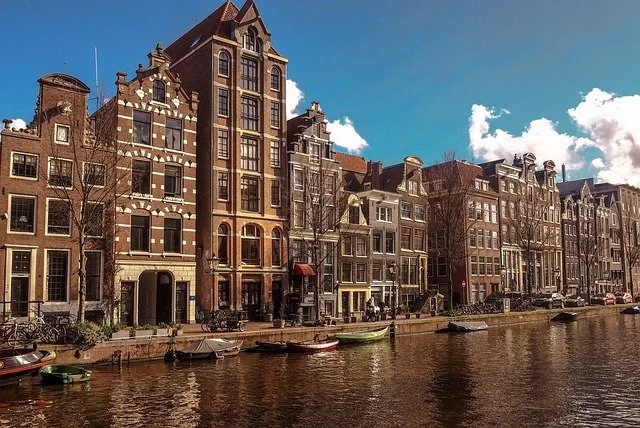
Royalty-free photo - pixabay
A departure at sea level. Literally.
Amsterdam, altitude 0 m. A flat, orderly landscape crisscrossed by waterways and bicycles. Here, ultra-distance takes on its true meaning: you start off without resistance, letting your legs find their rhythm on these long, straight roads swept by the north wind.
The road leads to Rotterdam and then Gouda—because in the Benelux countries, a good beer often starts with a little cheese. The urban skyline fades away, replaced by dykes and the great Dutch plains. The pace is fast and clear. A first invitation to manage your effort wisely.
A journey through the strange geography of borders
Baarle-Hertog / Baarle-Nassau. A puzzle unique in Europe: Belgian enclaves in the Netherlands, sometimes house by house. Riding here, you feel that this race is not just about exploring landscapes. It also explores the history of borders and the strangeness of the territory.
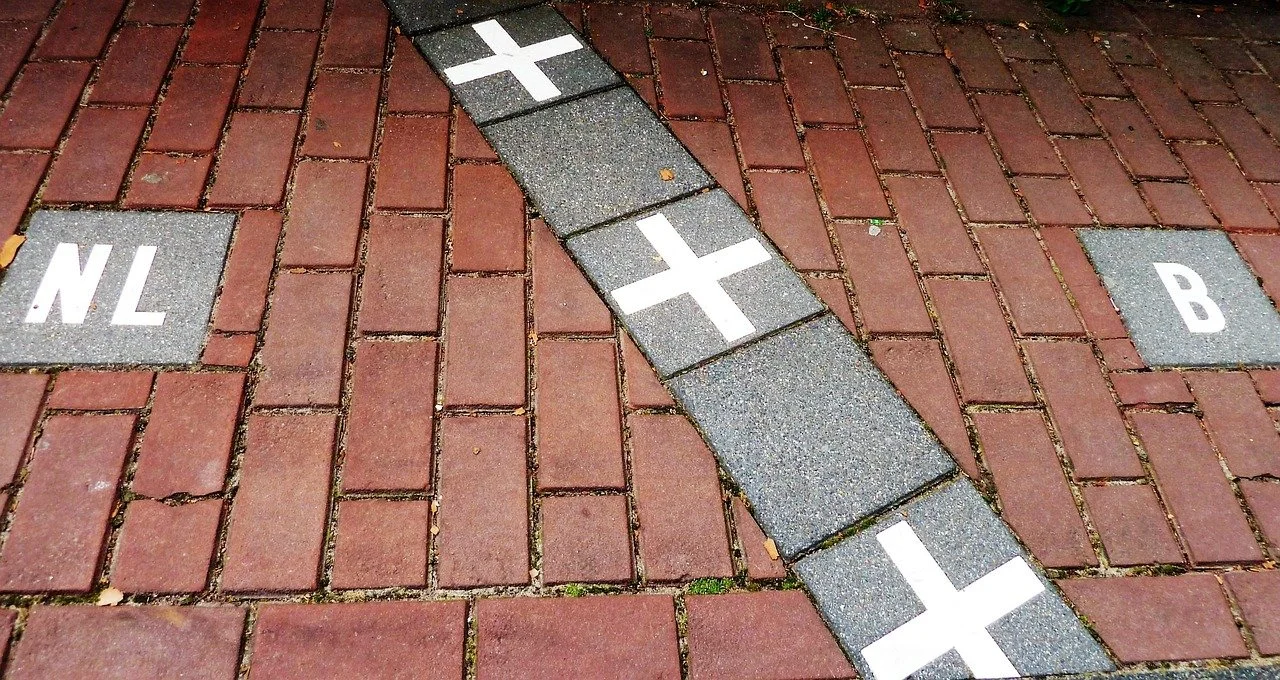
The border between Belgium and the Netherlands - royalty-free photo
Entering Belgium: the Campine region and the first hills
In Achel, monastic tradition guides the way. The road becomes more uneven, less smooth than the previous kilometers. The terrain begins to breathe—short embankments, small inclines, a more choppy rhythm. Belgian Limburg sets the tone: here, nothing is very high, but nothing is really flat either.
And then there's a name that resonates with cyclists: the Cauberg, in Valkenburg (Netherlands). The deciding factor in the Amstel Gold Race
A short, steep climb, famous for its drama during the world championships. A first reminder: the Benelux countries know how to make it tough, even without altitude.
From the Fagnes to the Grand Duchy: the wild diagonal
The trail then plunges into the Hautes Fagnes, a mineral and unspoiled area, before running alongside the Gileppe dam, imposing, silent, almost intimidating in its tranquility.
Then comes the border. Luxembourg opens up at Troisvierges, the gateway to a compact, dense, and surprising country. The landscape becomes more rugged: deep valleys, thick forests, rhythms that break the line.
The Mullerthal, nicknamed "Little Switzerland," offers an unexpected backdrop: sandstone cliffs, narrow gorges, and winding roads. Then there's Vianden and its hilltop castle, one of the most beautiful cycling panoramas in the country.
The final stretch to Arlon: dry ramps, a scent of challenge
Final kilometers: back in Belgium. The Waltzing–Chapelle Rentert section gets your legs moving again. Short, sometimes brutal climbs appear just as the odometer hits 500.
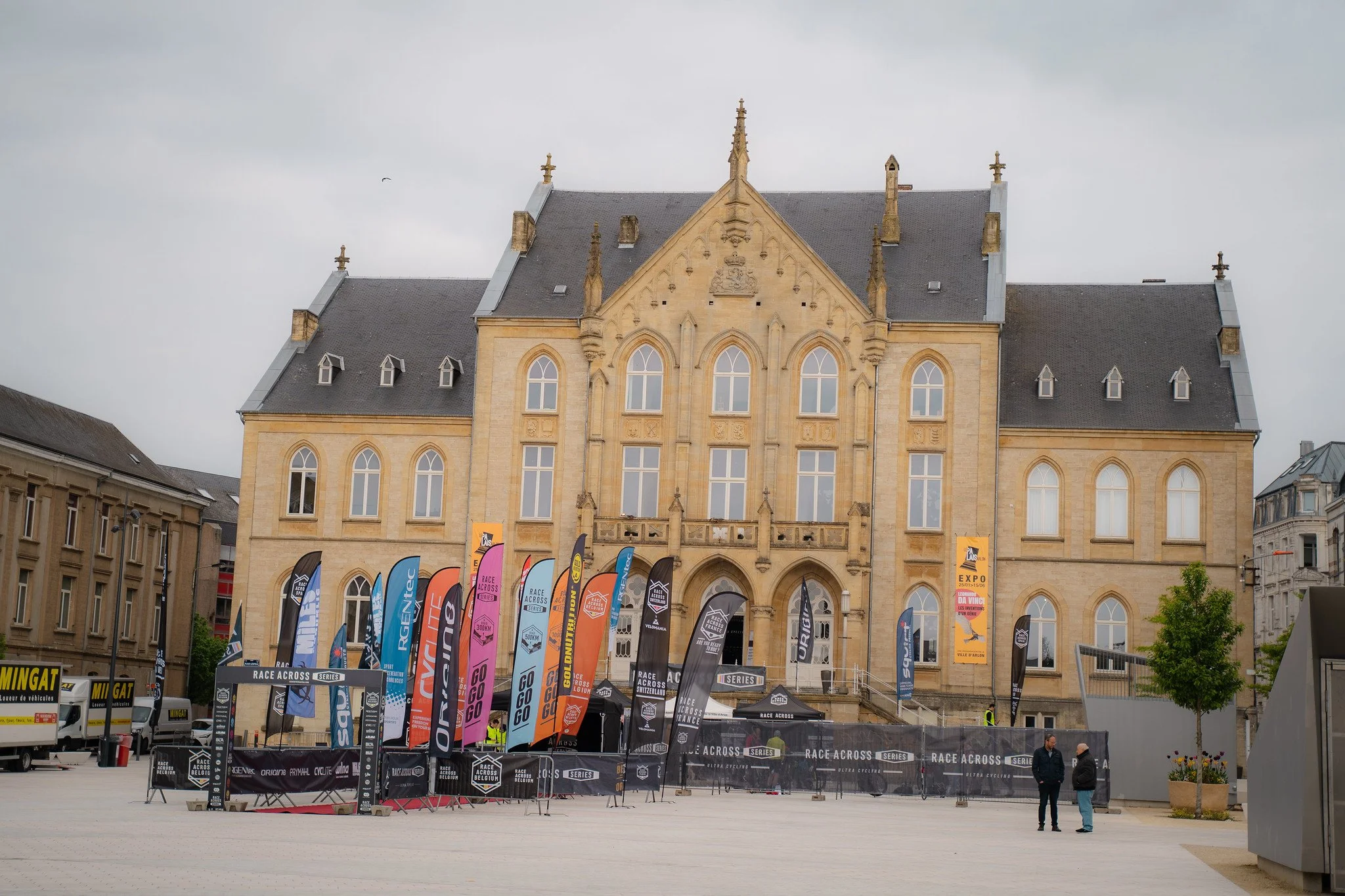
The square in ARLON, Belgium - photo: @jennifernguyen.p @tristankz_ @tristan.dkg
It's an arrival in Arlon with the taste of beer, sweat, and character. A miniature journey across Europe, from one country to another, from one culture to another, without ever breaking the thread of the journey.
In one sentence
A distinctive Amsterdam → Arlon route, combining wide plains, challenging climbs, and beer-friendly culture, for an energetic arrival in the Arlon region.
ACT 2 — Arlon → Arlon (533.5 km – 7,206 m elevation gain)
The Ardennes without filters. Beer as the common thread. Luxembourg as a neighbor. A demanding, leg-breaking loop that is deeply rooted in identity.
If the first part is a crossing, the second is an immersion. A circular journey, more technical, more challenging, more intense. Here, the Benelux reveals its mountainous side —yes, mountainous—with 7,165 m of elevation gain over 533 km.
The first valleys: Attert, Upper Sûre
The loop leaves Arlon towards Luxembourg, heading for Redange-sur-Attert, a former brewing region. The valleys follow one after another: Attert, Haute-Sûre, then the entrance to the Ardennes.
The landscapes become rougher. Deep forests, powerful rivers, villages clinging to the slopes. The road rolls on, but never for long: it is the very definition of a leg-breaking profile.
Luxembourg's brewing industry: history and culture
In Wiltz, the historic heart of the country, runners pass through an area where beer is part of the heritage. Brasserie Simon, national museum: a symbolic stop on this loop that combines endurance, geography, and local culture.
The Belgian Ardennes: a landscape with character
Houffalize. La Roche-en-Ardenne. Names familiar to fans of cycle touring, mountain biking, and demanding classics. Short, steep climbs, often through forests, with sometimes rough asphalt but a unique atmosphere.
The route then plunges towards the Meuse at Dinant, majestic, vertical, theatrical.
Then the Ourthe, the Lesse... these steep-sided valleys where villages seem frozen in time.
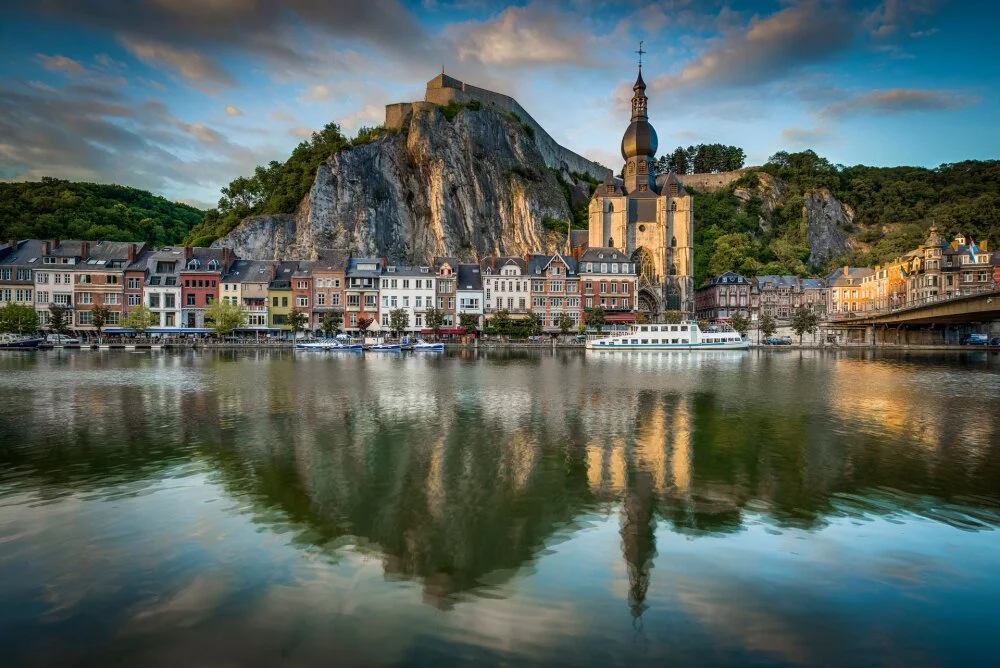
Dinant - Belgium -
Lakes, parks, natural enclaves
Head for the Eau d'Heure lakes, then the Entre-Sambre-et-Meuse National Park, a wild and unspoiled area. From the ponds of Virelles to Gaume, the trail becomes brighter, wider, almost southern in tone. Belgium reveals itself to be diverse and deeply alive. The Benelux fades away: it is nature that speaks.
The common thread of beer — Achouffe, Rochefort, Chimay, Leffe, Ciney
It's no longer just a journey. It's a pilgrimage into the brewing culture of the Benelux countries:
Achouffe and its legendary emblem (The Chouffe dwarves)
Ciney, its squares, its towers, its beers
Leffe, abbey, history, golden stones
Maredsous, its monastic traditions
Chimay, an essential Trappist beer
Rochefort, power of the Ardennes and Trappist excellence
A succession of places that tell the story of a country in a different way than through its roads.
An intense finale: the Hirtzenberg, then the descent to the finish line
Last challenge, last test. The Hirtzenberg, short in length but intense. The kind of climb that makes your legs talk after 950 km.
Then the road takes a turn. We descend towards Arlon, with that very special feeling of coming home after a long, intense, almost initiatory journey.
Race Across Benelux 1000 km
An adventure in two chapters. Two territories, two interpretations, two different endeavors.
But one spirit: that of intense, cultural, authentic ultracycling rooted in the history of three countries that are different but complementary.
Race Across Benelux – 500 km
IDENTITY SHEET — RACE ACROSS BENELUX 500 KM
🏁 Format: 500 km (200 km loop + 300 km loop)
Date: race bib collectionMay 28, 2026 / start May 29, 2026 at 8:00 a.m.
📍 Start/Finish: Arlon (Place Léopold)
🌍 Countries crossed: Belgium ↔ Luxembourg
📏 Total distance: 528+ km
⛰ Total elevation gain: ≈ 8,550 m D+
🔁 Concept: Two separate loops – an easy logistics format / a complete overview of the territory
🗺 Territories crossed:
Attert Valley
Anlier Forest
Upper Sûre & Esch-sur-Sûre
Luxembourg City
Gaume (Lamorteau, Virton, Meix-devant-Virton)
Orval & its monastic forests
Florenville & Bouillon
Ascent of the Semois Valley
Ardennes & Arlon region
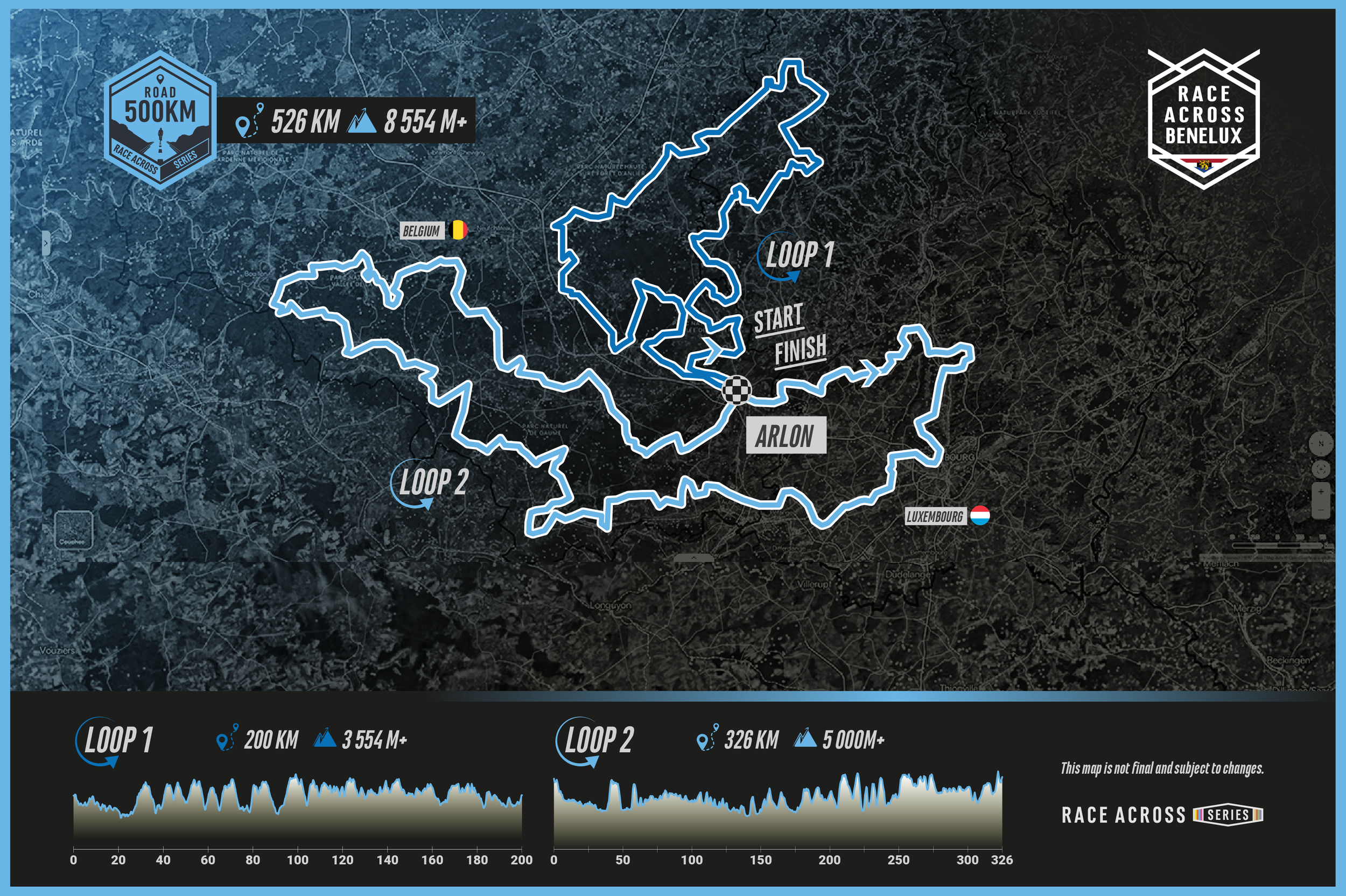
Illustration: Race Across Benelux - Edouard Hanotte
Two loops, one story: endurance in circular format
The 500 km format of the Race Across Benelux is not simply a division of the route: it is a philosophy. A concept designed to facilitate logistics while offering a dense, coherent challenge deeply rooted in the identity of the territory: that of southern Belgium and Luxembourg, between the Ardennes, Gaume, deep valleys, and omnipresent brewing culture.
Comprising two complementary loops — 200 km (Belgium ↔ Luxembourg, Anlier Forest, Haute-Sûre, craft breweries)+300 km (Valley of the Seven Castles, Luxembourg City, Gaume, Orval, Semois, Ardennes)—the 500 km route offers a comprehensive view of rural and border areas in the Benelux region.
Whereas the 200 km loop focuses on intensity and density, the 300 km loop tells a story of scale, cultural transitions, and deep valleys. Together, they form a two-chapter narrative, starting and ending in Arlon: two different journeys, but with a common thread— endurance, terrain, and beer as a cultural language.
This format offers a unique interpretation of the terrain: no alpine climbs, but a succession of hills, valleys, and sprints that gradually wear you down, an ideal challenge for endurance cyclists who like to manage, absorb, sprint, and hold out over the long haul.
Here are the details of the two loops:
Loop 1: Race Across Benelux – 200 km loop:
A distillation of the Ardennes, Luxembourg, and brewing culture
While the 1,000 km route recounts an odyssey across several borders, the 200 km loop is its essence: a short, fast-paced, dense format, created for those who want to experience the spirit of the Benelux at its most authentic—its steep-sided valleys, deep forests, brewing villages, and roads that never stop climbing.
Created by Ben Georges, this 202 km loop with 3,553 m of elevation gain is a complete challenge, demanding but accessible to any cyclist willing to maintain a constant effort over an intense day at altitude, rich in culture... and character.
Departure and arrival at Place Léopold, in the heart of Arlon: a welcoming urban setting to launch a 100% cross-border journey.
Departure from Arlon: leaving the city behind to enter nature
Arlon awakens, cafés open their doors, cobblestones echo under wheels.
Quickly, the city gives way to rolling countryside: small farm roads, Ardennes groves, and the first ramps that set the tone.
Here, nothing is flat. Every bend hides a new hill, every descent opens onto a valley. The ultra begins from the very first kilometers, not in terms of distance, but in terms of pace—a series of short, sometimes steep climbs that require intelligent effort management.
Luxembourg as a neighbor: culture, landscape, identity
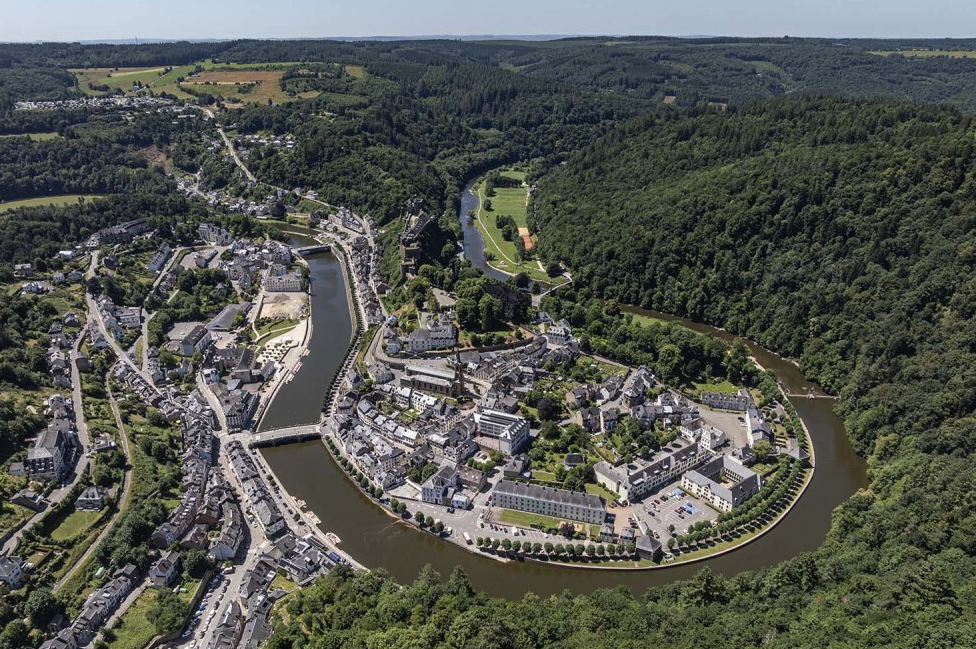
Once you cross the border, the Grand Duchy offers a different setting: perfectly smooth roads, immaculate villages, and valleys full of character.
It's a different way of riding: more in the forest, more enclosed, quieter.
The route crosses the Attert Valley Nature Park before heading into the foothills of the Upper Sûre. The lake at Esch-sur-Sûre and its monumental dam lend an almost alpine feel to the landscape, with steep walls and sharp bends.
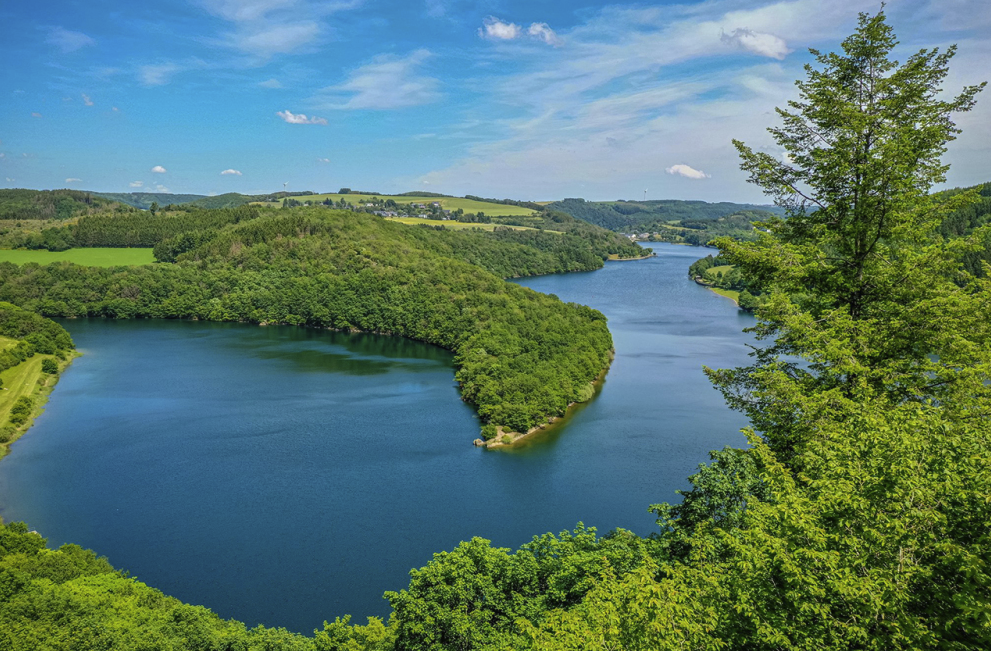
Here, the effort is constant: never violent, but never slackened.
The common thread in brewing: breweries that tell the story of their region
This loop is not just a long outing: it is also a journey through the brewing traditions of the Benelux countries.
As you travel along, the locations follow one another like a living map of expertise:
Brasserie d’Arlon Cooperative – locally based, modern, committed
Brasserie de la Pa (Metzert) – strong local identity
Brasserie du Cochon Fantôme (Tontelange) – artisanal rock 'n' roll
The Horn of the Hanged Man's Wood – symbol of local folklore
La Frontabière (Martelange/Rombach) – a border brewery, straddling two countries
Simon Brewery & National Beer Museum (Wiltz) – Luxembourg's brewing capital
Ebly – known for its iconic horn-shaped glass
It is another kind of breadcrumb trail:a route that connects people, artisans, places, stories—as well as landscapes. Driving here means understanding that the Benelux is not just a geographical area: it is also a vibrant and generous culture.
Return to Arlon: forests, plateaus, changing light
The loop returns to Belgium through the Anlier Forest, one of the country's most unspoiled forests. Long wooded stretches, clearings, winding roads, and successive bumps punctuate the return journey.
The landscape becomes more open as you approach Gaume: plateaus, villages with light-colored walls, and an almost southern atmosphere depending on the light.
Then, little by little, Arlon reappears. Its rooftops, its central square, its familiar presence. The loop closes exactly where it began, with the feeling of having traveled through a complete, coherent, profound territory.
Loop 2: Race Across Benelux – 300 km loop:
A journey of identity between Arlon, Luxembourg, and the deep valleys of the Semois**
The 300 km loop is a long, intense, demanding journey. It is a format that does not seek out Alpine passes or very long climbs, but draws its difficulty from elsewhere: from the accumulation of effort, from the hills that appear without warning, from the succession of valleys, from the geography of the southern Benelux region, which never ceases to breathe in waves.
With 326.6 km and 4,999 m of elevation gain, this route tells the story of a border region rich in culture: Belgium, Luxembourg, Gaume, the deep valleys of the Semois, the fast-flowing plateaus, and the forests of the Ardennes. It is an endurance challenge, but also a story—a thread that connects landscapes, towns, villages... and breweries, true markers of the region's identity.
Arlon, anchor point and starting point for a long round trip
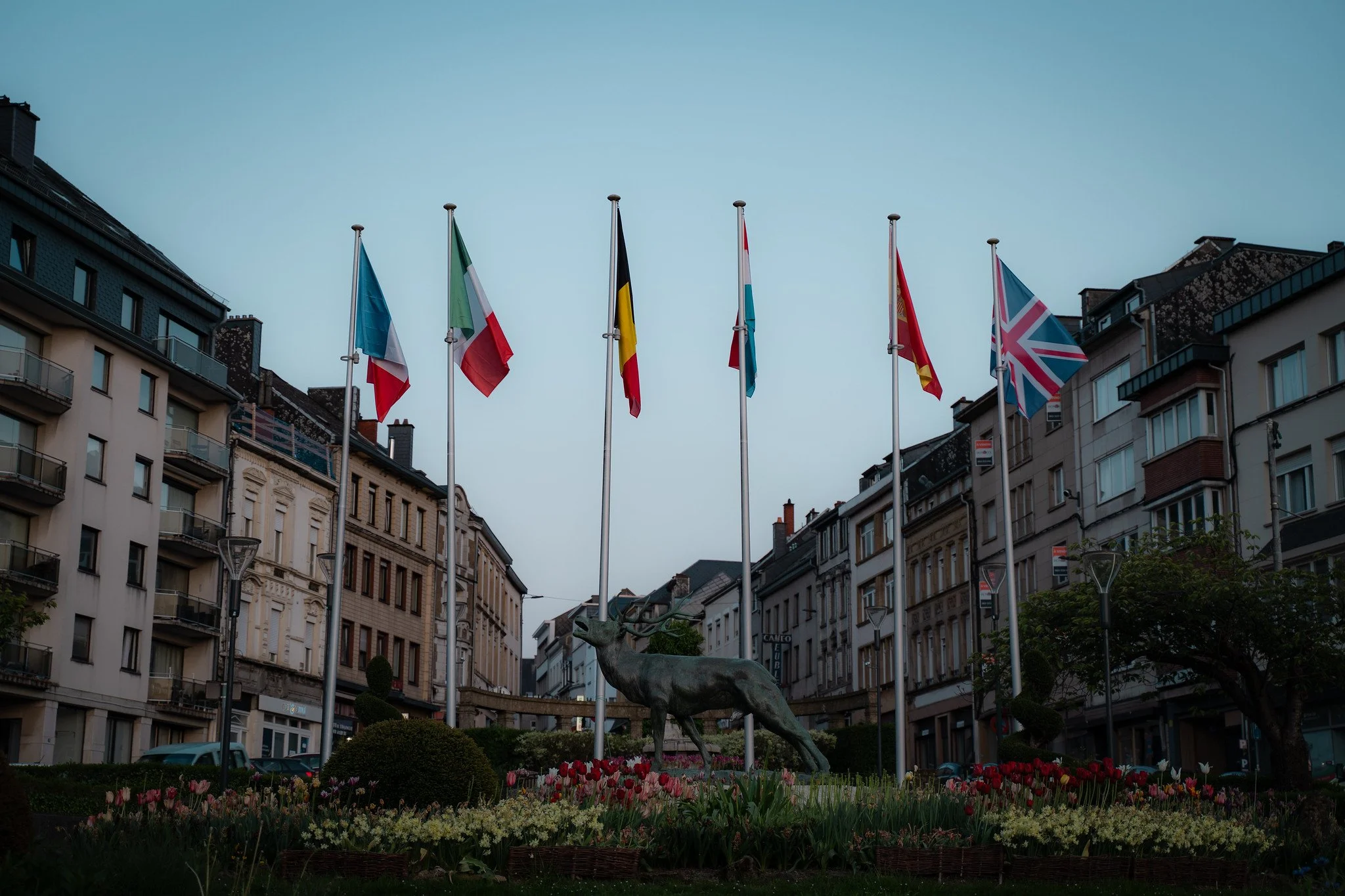
The departure is from Arlon, a crossroads town, a border town, a town steeped in history. Just outside the center, the roads rise gently. The tone is quickly set: undulating, never really flat, never quite steep—but always lively.
The road winds its way towards Luxembourg, the first border, the first cultural transition, the first break in rhythm.
The Valley of the Seven Castles: heritage and winding roads
It is one of the most remarkable landscapes in the Grand Duchy. A corridor of narrow roads, deep forests, and medieval silhouettes. Castles sometimes appear in the distance, sometimes almost above the roads.
The effort here is as much mental as it is physical:short, repeated climbs, perfect asphalt that encourages you to speed up, but terrain that quickly brings you back down to earth.
Then, almost without transition, the route reaches Luxembourg City via the Eich coast, still used by the prologue of the Tour de France and the Tour of Luxembourg. A unique blend of modernity, steep-sided valleys, and monumental bridges. A capital city that you pass through not for its urban planning, but for the visual experience of traveling from canyon to canyon.
Back to Belgium: Gaume and its unique atmosphere
Head south to Belgium, close to the French border. Gaume is a unique region: brighter, with gentler landscapes and a more southern feel, but just as challenging in terms of terrain.
Lamorteau, Virton, Meix-devant-Virton... Villages that seem carved out of an ancient tranquility. An alternation of open fields, forest edges, and small roads that wind around the bocage.
Then comes one of the most iconic parts of the loop: Orval. Its abbey, its forest, its monastic atmosphere—and its iconic beer. It is a powerful symbol of the route, a deep link between culture, territory, and endurance.
The Semois: deep valleys, magical roads
The line climbs back up towards Florenville, then Bas les Gorges. The landscape becomes more confined.
The forests grow denser, the valleys deeper, the roads more winding.
In Bouillon, the silhouette of the castle dominates the river, serving as a reminder that this region has always been a land of passage, battles, and stories. The Semois then unfurls its ribbon of water and roads, in one of the most beautiful settings in Belgium.
This is where cumulative fatigue begins to take its toll: the hills are short but frequent, the pace is constantly changing, and the tempo is never steady. Pacing yourself is key:
conserve energy on the hills, maintain a steady pace on the rolling valleys, and eat regularly in preparation for the final stretch.
The brewing trail: a route that showcases expertise
As you travel along, the breweries form a cultural trail:
B.A.C – Arlon Cooperative Brewery
Clausen Brewery (Mousel) in Luxembourg City
Bofferding in Bascharage
The Gaumaise in Meix-devant-Virton
Brasserie des Trévires (Lamorteau)
Les Géroublonades (Gérouville)
Godefroy beer in Bouillon
MilleVertus (Breuvanne)
The Bell (Stall)
and Orval, an icon among icons
These breweries are not just dots on a map: they embody the region, its traditions, its history, and its creativity.
The 300 loop tells the story of the region through its beers as much as its landscapes.
A finale by Hirtzenberg: where effort becomes history
Last challenge: the Hirtzenberg, the highest point in the area, a tough climb, symbol of the region. Short, but demanding. And above all, deeply symbolic.
Because here, everything comes full circle: the Semois River, which originates in Arlon, is part of the story. The region tells its story in cycles. And so does the loop.
After this final test, the road plunges towards Arlon, towards the finish line, towards the feeling of having crossed an entire country—perhaps two—in a compact but incredibly dense format.
And for those who want to get started: the 200 km and 300 km formats—including a 200 km by night to get used to running at night.
IDENTITY CARD — RACE ACROSS BENELUX 300 KM
📅 Date:
race bib pickup race bib May 29, 2026
Departure: May 30, 2026, at 8:00 a.m.
🏁 Format: Long, challenging loop (Arlon → Arlon)
📍 Start/Finish: Arlon
🌍 Countries crossed: Belgium ↔ Luxembourg
📏 Distance: 326.6 km
⛰ Elevation gain: 4,999 m D+
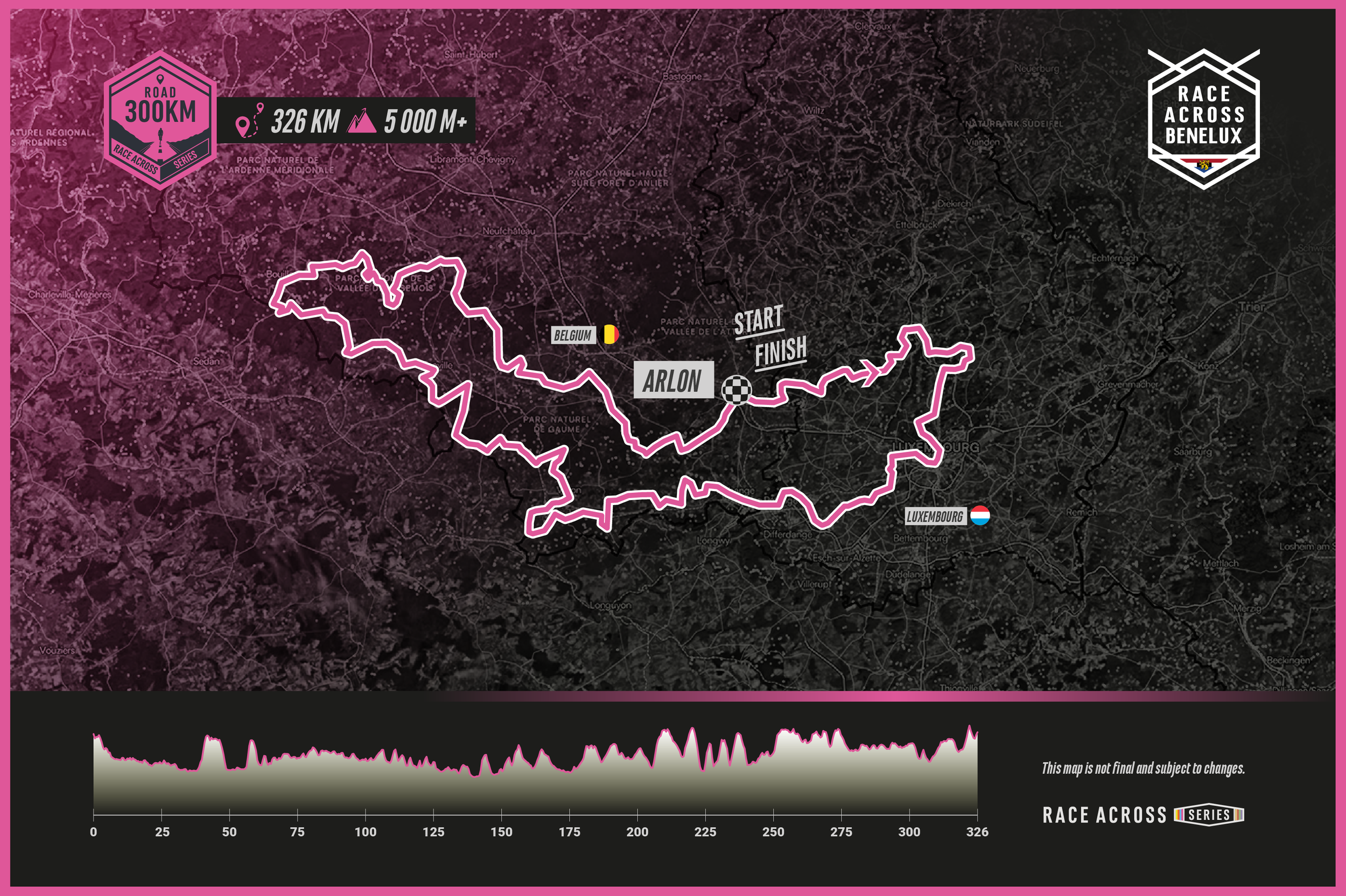
Illustration 300km - RAB - Edouard Hanotte
IDENTITY CARD — RACE ACROSS BENELUX 200 KM
📅 Date:
race bib pickup race bib start: May 30, 2026
Departures: from 8 p.m.
🏁 Format: Compact, hilly loop (Arlon → Arlon)
🌍 Countries crossed: Belgium ↔ Luxembourg
📏 Distance: 202 km
⛰ Elevation gain: 3,553 m D+
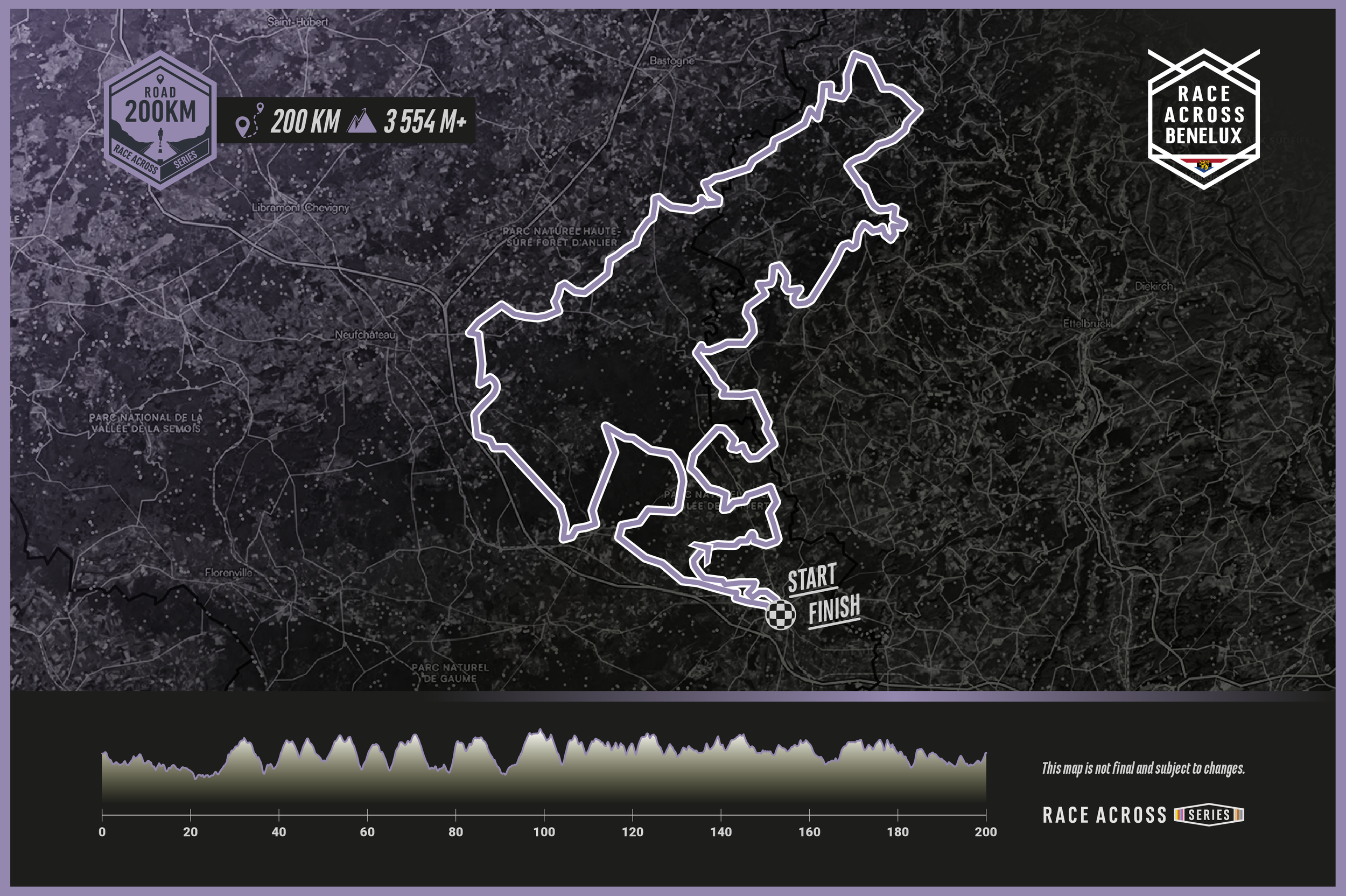
Illustration 200km RAB - Edouard Hanotte
The 200 km and 300 km formats directly replicate the two loops that make up the 500 km experience. These are not simplified routes: they are exactly the same trails, designed to offer total immersion in the Benelux, but with a more accessible approach depending on each person's level or objective.
The 200 km by night is designed for those who want to discover ultra running in a controlled environment: a reasonable distance, a safe setting, and above all, a unique opportunity to learn how to manage nighttime running, lighting, pace, and concentration. A challenge on a human scale, perfect for progressing.
The 300 km route offers a longer and more challenging experience, with an iconic passage through Gaume, Orval, Semois, and the deep valleys of southern Benelux.
Two formats designed to get started, test yourself, challenge yourself—or gently prepare for the full 500 km adventure.
Conclusion — The Benelux as a new playground for ultra cycling
With its 1,000 km, 500 km, 300 km, and 200 km formats, Race Across Benelux has established itself as one of the most comprehensive and distinctive events in modernultra cycling. Fast plains, Ardennes valleys, border forests, brewing culture and villages steeped in history make up an ideal territory for those seeking a challenge that combines performance, adventure and discovery. Designed in the spirit of the Race Across Series, this new destination offers a demanding but accessible experience, perfectly suited to endurance cyclists, sporty bikepackers, and anyone who wants to take their long-distance cycling to the next level. In Benelux, ultra-distance takes on a new dimension: authentic, cross-border, immersive—an invitation to ride far, long, and write your own chapter of ultra cycling.
Watch last year's film:
To register, click here: https://www.raceacrossseries.com/race-across-belgique-2025
