
GRAAALPS 2025: Looking back on Alain Rumpf's epic journey
A PIZZA LOST IN THE NIGHT
There are stories that perfectly capture what GRAAALPS represents: an ultra-distance gravel and bikepacking adventure that is raw, demanding, and deeply human. Alain's story is a perfect example.
Over 800 km between Crans-Montana and Mandelieu, he experienced the essence of alpine bikepacking: wild mountain passes, equipment choices that suddenly take on their full importance, improvised bivouacs, all-too-rare coffee... and that famous panino with speck and blue cheese, a reminder that ultra-distance cycling is also an immersion in local culture and cuisine.
In this interview, Alain looks back on the highlights of his GRAAALPS adventure: the legendary gravel sections—sometimes rolling, often unforgiving—the spectacular Alpine passes, the moments of doubt, the small victories, and the magic that is unique to adventure: silence at high altitude, a sunrise, an impromptu concert in a village, or a sandwich that becomes a memory for life.
A sincere, funny, and lucid account that illustrates better than anything else the richness of long-distance bikepacking in the Alps.
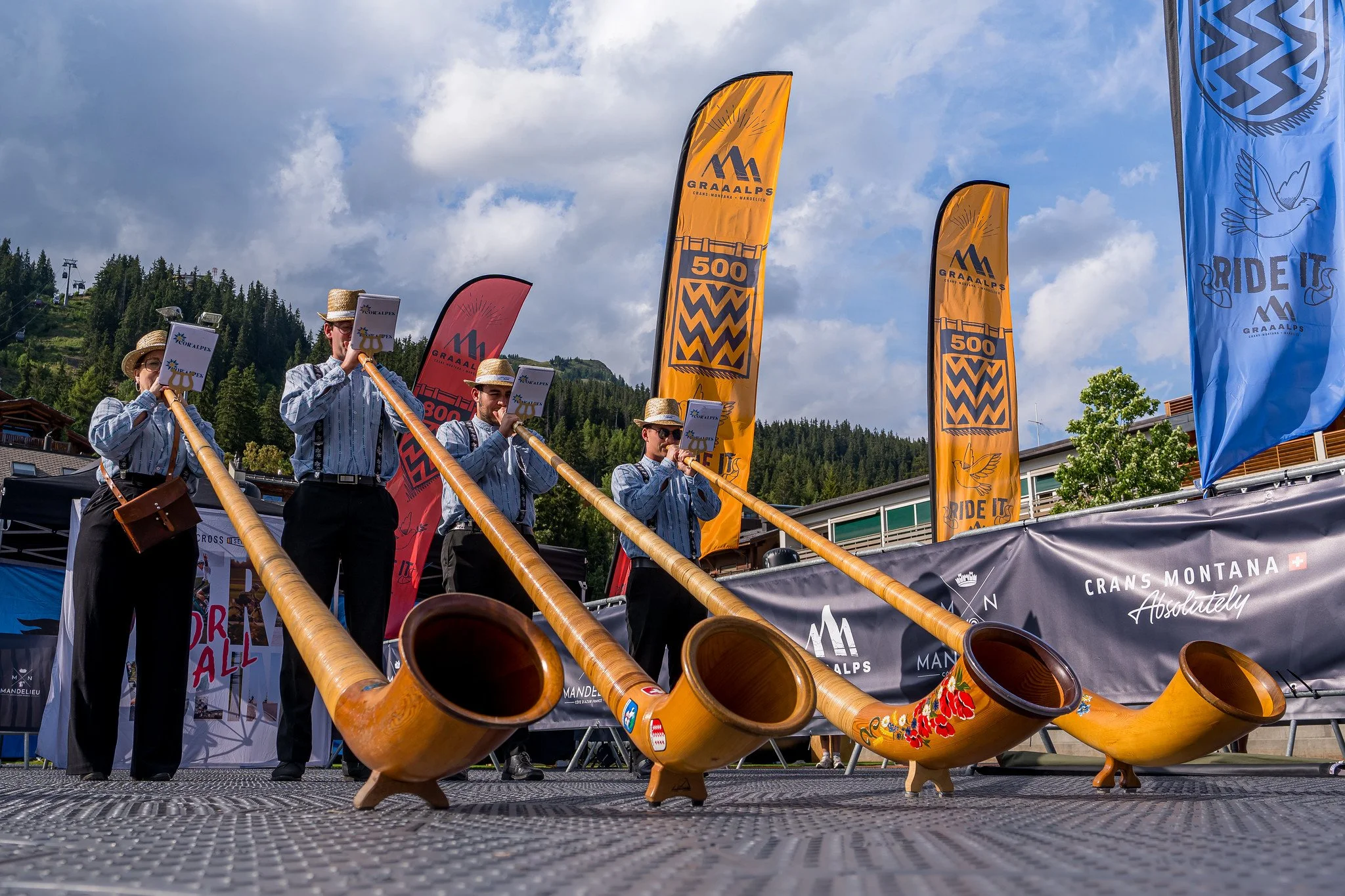
The Swiss spirit of GRAAALPS departing from Crans-Montana in July 2025 - photo: @Edouard Hanotte
Alain, when you think back on those 800 km between Crans-Montana and Mandelieu, what is the very first memory that comes to mind?
A speck and blue cheese sandwich.
On the morning of the fourth day, I stopped in Sant’Albano Stura, a village between Turin and Cuneo. At the grocery store, in addition to the Coca-Cola and Snickers bars that form the basis of my diet on bikepacking trips, I treated myself to a sandwich. But not just any sandwich.
In Italy, you can get homemade sandwiches made for you in most grocery stores, even the smallest ones offer a selection of cheese and cold cuts. In my hesitant Italian, I gave the owner carte blanche to make me "his best panino." He reacted as if I had given him a sacred mission. He thought carefully before choosing speck (smoked raw ham typical of the Italian Tyrol) and a local blue cheese.
I ate my sandwich a few hours later, as I approached the foot of the Col de la Lombarde. Even though digesting the blue cheese slowed my climb down a bit, this sandwich gave me the joy I seek through bikepacking: discovering a country, its people, its cuisine, and its traditions.
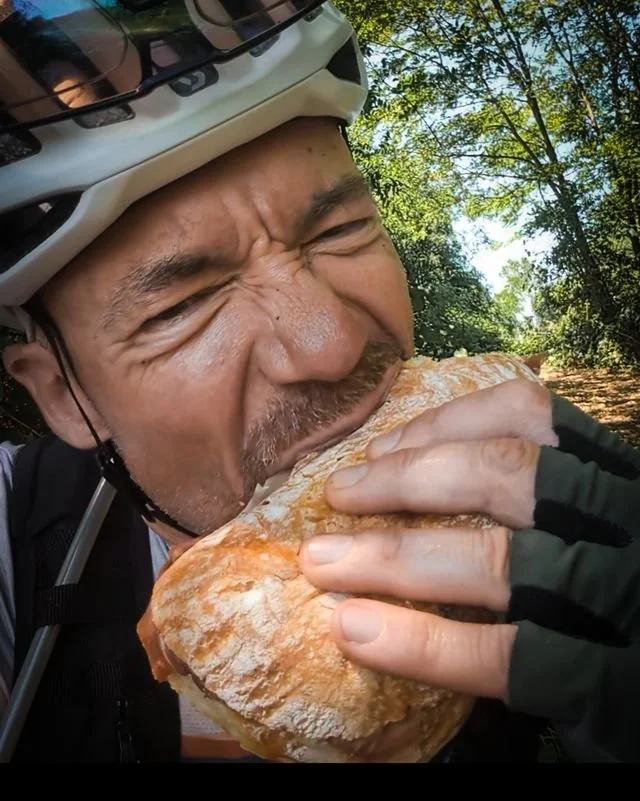
Alain Rumpf and his speck and blue cheese sandwich - photo credit: @aswisswithapulse
What was the passage or section that best symbolized the GRAAALPS spirit for you: raw, beautiful, demanding, but incredibly rewarding?
The Passo San Giacomo, of course. By bike, there aren't many passes between Valais and Italy, a region dotted with 26 peaks over 4,000 meters high. I didn't know this pass, which on the map involved a small detour through Ticino from the Nufenen Pass.
The climb up the pass turned out to be more than just a little detour, and I understood why this Alpine route remains relatively unknown among cyclists. I battled for two hours to reach the summit at 2,307 meters, first on my bike, then on foot. As I like euphemisms, I would say that it wasn't exactly smooth sailing. And at the summit, the hikers and (electric) mountain bikers were a little surprised to see me arrive.
For me, Passo San Giacomo perfectly matches my idea of alpine bikepacking. It's adventure with a small "a," the thing you didn't know you needed.
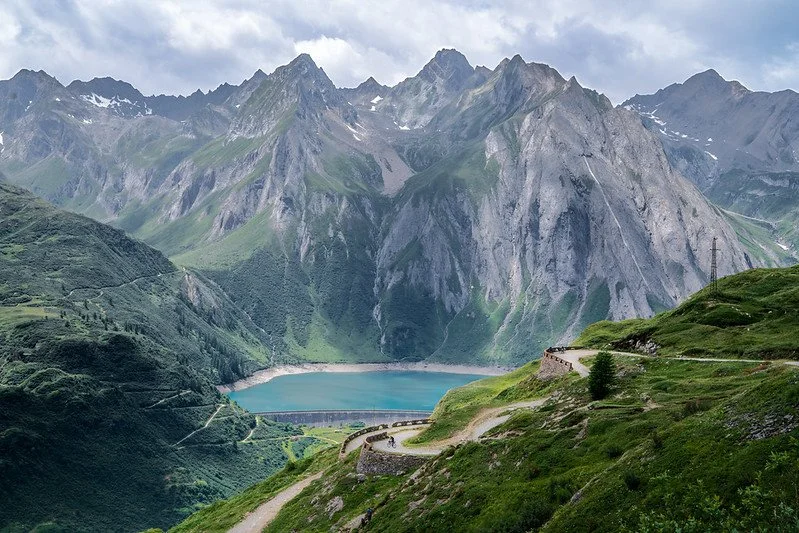
Passo San Giacomo - crossing from Switzerland to Italy on the GRAAALPS 2025 - photo: @Edouard Hanotte
Was there ever a moment of doubt, of mental breakdown?
How did you deal with it, and what made you keep going when things got really tough?
Yes. Two, in fact.
First of all, I set off from Crans-Montana with a pizza cut in half and tied to the top of my saddle bag. Clearly, that wasn't enough: one half fell off along the way, and I noticed it around 2:30 a.m. when I stopped to camp in the Conches Valley. It was a very difficult moment, and I felt a terrible emptiness (in my stomach) when I finished eating the half that was left.
Fortunately, the half pizza wasn't lost. My friends Svenja and Bastien found it on their way and ate it a little later. Of course, they sent me a photo. And that was even harder.
The second difficult moment: the morning of the fifth day. After camping on the slopes of the Col de la Couillole, I set off again at around 4:30 a.m. and arrived in Touët-sur-Var at around 7 a.m., before the village bar opened. As a result, I had to ride for another three hours to cross a hill in the middle of nowhere before finding an open café in Roquesteron.
Almost six hours on the bike before my first coffee: I wouldn't wish that on my worst enemy (that's just an expression; I don't think I have a worst enemy in my life).
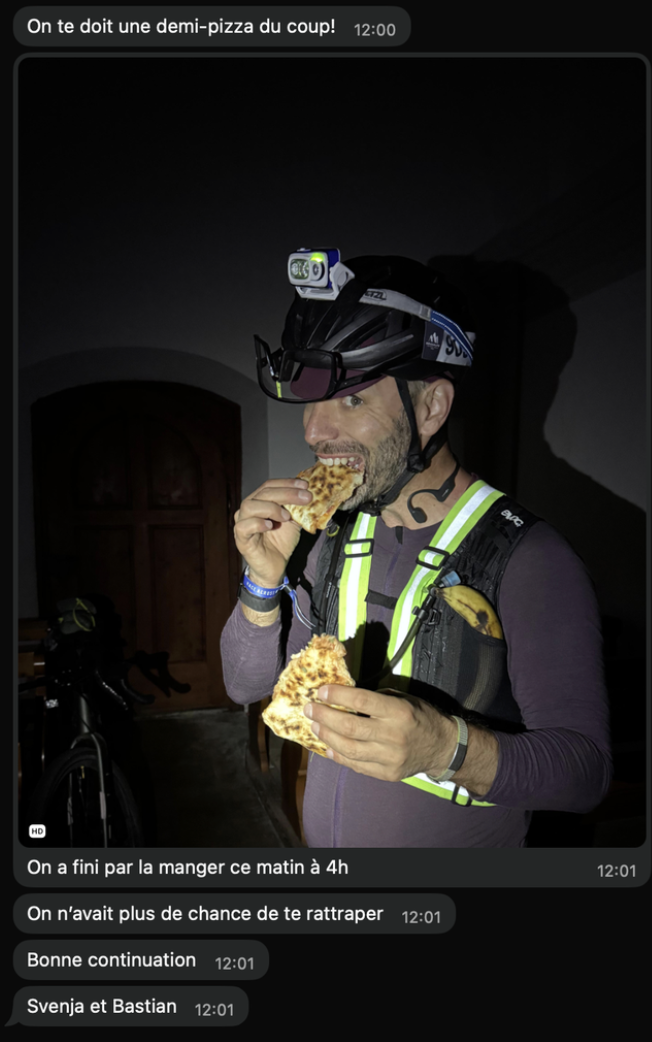
Alain's pizza, found by his friends Svenja and Bastien
On a self-supported trail like GRAAALPS, every choice counts. Was there one decision (equipment, pacing, sleep management, nutrition) that changed everything during your adventure?
On the Graaalps, I could have gone to the base camps, slept in the warmth, eaten properly, and chatted with other humans. But no, I chose to perfect my fledgling art of bivouacking.
Even though it may seem a little silly, I learned a lot from this experience: there are mosquitoes in the Po Valley, the air is cold near rivers, sleeping under an awning protects you from dew, animals make lots of strange noises at night, but the species found in the Alps don't want to eat you.
And now I feel like a semi-pro at camping. Thank you, Graaalps.
What did the Alps teach you about yourself during those 800 km?
That without coffee, I can't function.
And that I really love Italy.
What were the "magical" moments of the journey for you?
Those moments when you realize that the suffering is well worth the view, the silence, or the intensity of the moment.
I would say rather a succession of moments, at the end of the fourth day: after painstakingly reaching the summit of the Col de la Lombarde, I found my stride again on the tarmac of the descent to Isola 2000. On the map, the rest of the route towards Isola looked similar, but that wasn't the case: the trail took us onto a downhill track, where I was very proud to stay on my bike—in an upright position most of the time.
I arrived in Isola at 6:59 p.m., just in time to rush into the village grocery store, which was closing. Victory! After stocking up on Coke, Snickers (and Haribo), I sat down at a restaurant terrace to eat my real daily meal. While waiting for my lasagna (not great, I was no longer in Italy), I was treated to a live concert in the village square. A local band notably butchered "J'ai Vu" by Niagara, the idols of my youth.
Then, another change of scenery: I left the musical frenzy of Isola behind to climb the Col de la Couillole at sunset. There wasn't a car in sight, I was climbing alone, and I was slow. My main distraction was reading the inscriptions on the road that had seen the Tour de France pass through the previous year.
Before reaching the summit, I was too tired, so I laid my mattress down at night in the first place I came across. There was sheep dung everywhere, but I didn't notice until it was too late.
A concentration of images, sounds, tastes, and scents: that is the magic of Graaalps.
How would you describe GRAAALPS to someone who has never set foot in this world? What sets it apart from other gravel or ultra adventures you've experienced? Because you've been on quite a few...
La Graaalps is a way to access a luxury that is rare these days: disconnection. For a few days, we have no choice but to leave behind the screens that pollute our lives. There is only one thing that matters: getting closer to the finish line. No more emails, no more instant messages, no more doomscrolling on social media. Instead: eating, riding, sleeping.
It's a little more painful than a digital detox retreat on a paradise island, but it's very effective.
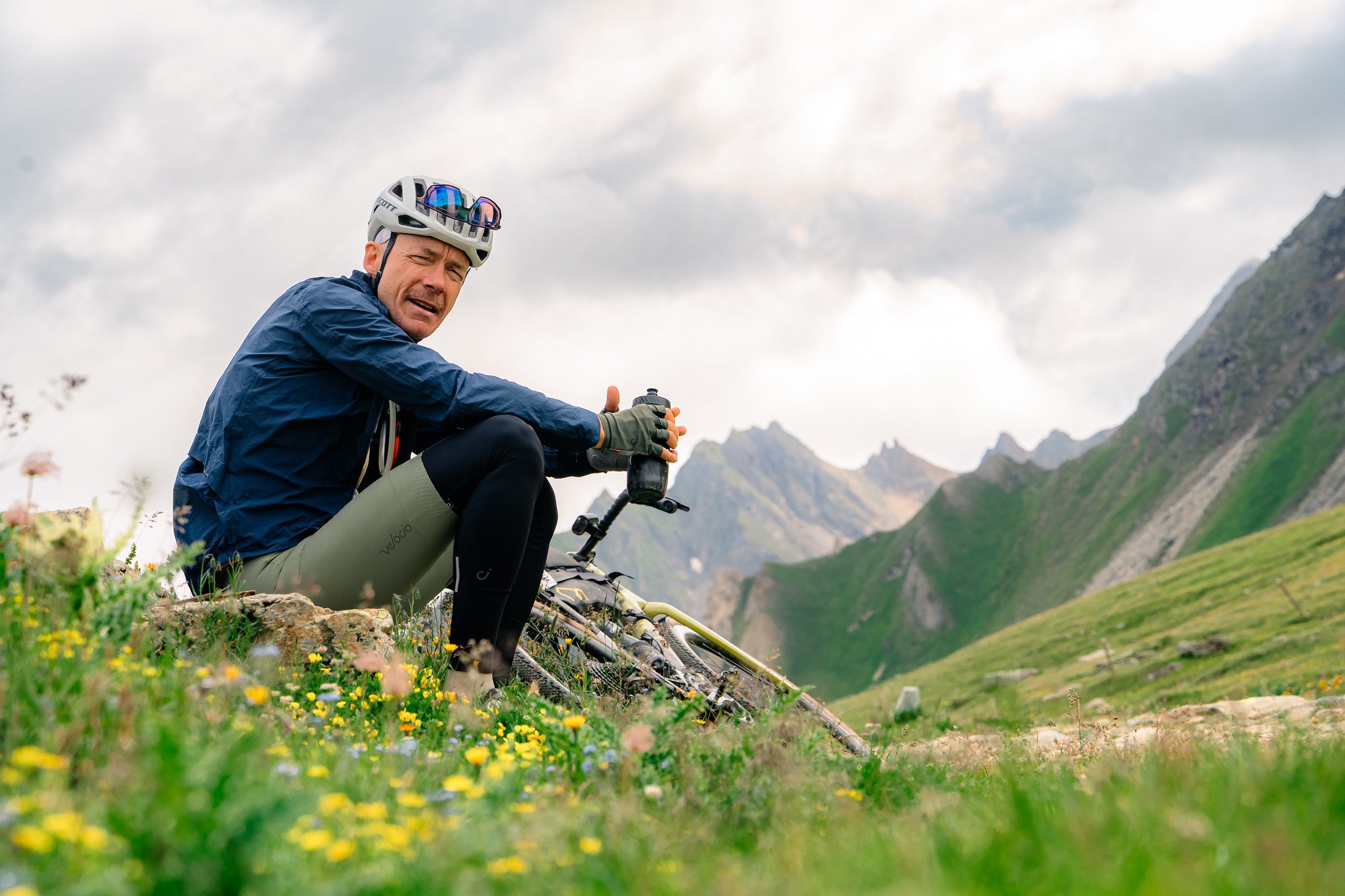
Alain Rumpf on GRAAALPS 2025, completely disconnected - photo: @edouard Hanotte
We understand that you haven't quite finished the adventure yet—can you explain?
Shortly after my life-saving coffee in Roquesteron, I noticed a slow puncture in the front tire. Nothing dramatic. By re-inflating it from time to time, I was able to continue on my way. Further on, near Gréolières-les-Neiges, I had to switch to plan B: a plug that lasted ten minutes, which was exactly the time it took to convince me that I was saved before proving that I wasn't.
Plan C: an inner tube, which lasted 40 minutes. The other two I had left didn't last long, so I activated plan D by calling all the bike shops in the area to find a solution. Unfortunately, I was far from anywhere, it was late on a Saturday afternoon, and no one could help me.
Up until then, I had handled everything logically. But at that point, my emotions took over. It was starting to rain, I had a train booked for the next morning to go home, and I couldn't see how I could make it to the finish line, which was only 70 kilometers away... I decided to scratch.
It's a classic ultra marathon scenario: an impulsive decision that seems obvious at the time but terribly stupid once the pressure is off. Of course I could have finished, I could even have walked and reached the finish line within the time limit the next evening! And taken a train home later. Or filled my tire with grass, clothes... you see all sorts of things in bikepacking races.
During the trip back, I felt really bad. But after all, it's just a bike race... and I learned a good lesson in mechanics: when riding tubeless, mini punctures sealed by the preventive liquid allow debris to enter the tire. So you have to take the time to clean the inside of your tire thoroughly before putting in an inner tube, even if you get it everywhere.
The moral of the story: whether it's a tire or your head, if you don't clean out what's inside, it will always end up exploding.
Will you come back?
I don't usually revisit the same races because there are so many events to discover... but in this case, I feel like something is missing, and I hear that the course will be very different in 2026. I'll reserve my decision ;-)
A final word to anyone who's still hesitating?
A lesson, an emotion, or something you want to share with those who dream of trying GRAAALPS 2025.
As Brendan Leonard so aptly puts it Brendan Leonard: "We all need to spend more time doing the things we love, going to places that remind us how small we are, laughing at ourselves, and occasionally feeling a little cold, a little hungry, a little scared."
Graaalps is the perfect opportunity to put into practice this precept from one of the great philosophers of our time.

A participant at the start of GRAAALPS 2025 - Crans Montana - photo: @Edouard Hanotte
Want to relive 2025? Click here: https://www.youtube.com/watch?v=d4uCDCwaOOw
Find out more about the route and GRAAALPS 2026: https://www.raceacrossseries.com/en/graaalps-2026
