
Managing sleep during ultra-distance races: The sleep rule in the Race Across Series
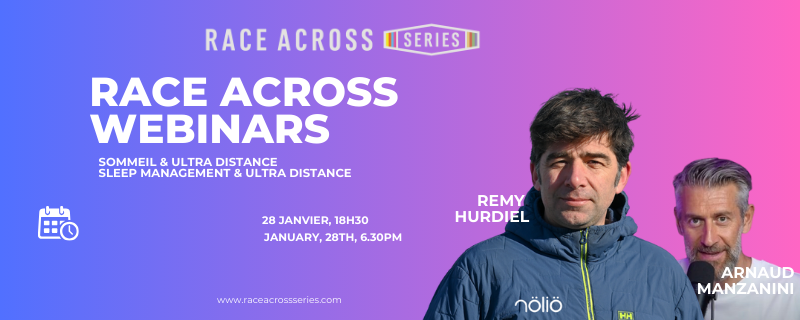
Image from the webinar on sleep
Understand, perform, ride safely
For several editions now, Race Across Series races have included a sleep rule.
Sometimes questioned, sometimes misunderstood, it is nevertheless based on solid scientific principles and a clear objective: to enable athletes to go far, for a long time, and safely.
To better understand its origin, how it works, and its real impact on performance, we asked Rémy, a sleep expert and researcher who initiated this study with the Race Across teams, 10 questions.
Where did the idea to implement a "sleep rule" on the Race Across come from?
The idea arose from a simple observation: certain behaviors observed in ultra-distance running were incompatible with the safe practice of this sport.
As in other endurance disciplines (ocean racing in the past, trail running sometimes still today), there was a strong belief that the less you sleep, the faster you go.
We were—and still are—convinced that this belief is false.
The sleep rule was therefore designed to:
Limit risky behaviors,
Put sleep at the center of practice,
And above all, serve as the basis for a genuine educational program to help athletes better manage their fatigue and develop their ultra skills.
What was the main problem observed before this rule was introduced?
The main problem wasexcessive sleepiness.
In practical terms, some cyclists were unintentionally falling asleep while riding, which represents a major risk:
falls,
accidents involving other road users,
inability to react to danger (turns, poor road conditions, animals, vehicles, etc.).
In ultra-distance racing, riders are solely responsible for their own safety.
However, a sleepy athlete no longer has the mental resources necessary to react correctly.
The aim of the rule is therefore to find the right balance between cycling time and fatigue management.
In practical terms, how does the sleep rule work?
The rule is deliberately simple and easy to understand:
4 hours of mandatory rest per 36-hour period
, calculated from the rider's departure time,
and accumulated using GPS data from the tracking system.
This makes it impossible to go two full nights without sleep while cycling.
What scientific evidence did you base your findings on?
Our research team at the Université du Littoral Côte d’Opale (Dunkerque) has been working on sleep and fatigue in sports for over 20 years, both in the field and in the laboratory, in all disciplines affected by sleep deprivation.
We have collected thousands of data points, both on land and at sea, which has enabled us to develop mathematical models that predict fatigue during exercise —an area of expertise that is now recognized internationally.
For Race Across, we simulated around twenty scenarios in order to develop a rule that:
respects the spirit of the ultra,
while remaining consistent with the scientific fundamentals of sleepiness regulation,
taking into account both the acute effects of sleep deprivation and the accumulation of fatigue over several days.
What does sleep deprivation actually do to the body and brain?
The brain is the cyclist's ultimate control center, regardless of their physical abilities.
When sleep is lacking:
cognitive abilities decline (organization, decision-making),
motivation becomes unstable,
emotions are more difficult to regulate,
As motor power decreases, the perception of effort increases.
But the most critical factor remains the ability to stay awake. When sleep debt becomes too great, the brain triggerssleep attacks: involuntary episodes of falling asleep, often without the athlete being aware of it.
It is this phenomenon that the rule aims to avoid at all costs, particularly during the second night, which is a particularly critical time.
Does sleeping really prevent you from performing well?
No. In reality, performance is based on a compromise we call WMG—Wakefulness Made Good.
Sleeping 8 hours a day like at home → too slow in competition.
Not sleeping at all → loss of power, errors, loss of mental control, accidents.
Our data shows that, for longer formats, WMG generally accounts for between 8% and 20% of the running time devoted to sleep.
This ratio depends on:
physical capacity,
of age,
of the total duration of the event.
In 2025, the winner of Race Across France was not the rider with the best FTP at the start, but the one with the best sleep/effort balance. All indicators therefore confirm one thing: the relationship between sleep and performance is very real.
How can you plan your race with this constraint?
The key is simple: respect natural rhythms.
Humans are diurnal:
we drive during the day,
we recover at night.
On very short races (1 to 2 nights), naps may suffice. But as soon as the event lasts 3 to 9 nights, nighttime sleep becomes essential.
Our data shows that:
Only a few highly trained athletes can manage with 1.5 to 2 hours of sleep per night.
Most runners need at least 4 hours of sleep per 24 hours on long runs.
Have you noticed any tangible effects since the rule was introduced?
Yes, very clearly.
Since the rule was introduced:
reports of hallucinations have virtually disappeared,
overall performance is better,
Accidents have become very rare.
The field teams—PGO, volunteers, and Sleep Angels —also play a key role, supporting athletes with kindness and clarity.
Does this rule take away the ultra spirit?
Absolutely not.
Quite the contrary.
The three main reasons to participate in a Race Across are:
push yourself safely,
have fun,
be effective.
The sleep rule is specifically designed to ensure these three dimensions. Even with this constraint, a Race Across remains—and will remain— an extraordinary challenge.
Could the rule change in the future?
Yes.
We continue to measure sleep and fatigue using strict scientific standards. The rule may change if new data or organizational constraints justify it (e.g., race start times).
But the spirit will remain the same: to enable athletes to fully experience ultra-distance running, in conditions that are compatible with performance and safety.
